
IN SHORT
- Build a gradient: a basking zone, a cool end and a hide that lets the animal choose. One “tank temperature” is not enough.
- Humidity is a range across the enclosure, not one number on a gauge. Measure the warm and cool ends separately.
- UVB must reach the animal unfiltered by glass or clear plastic; the lamp guide is a starting point, not a permission slip.
- Log the readings after every change. A setup that works in winter may fail in summer, or the reverse.
1. The thermal gradient comes first
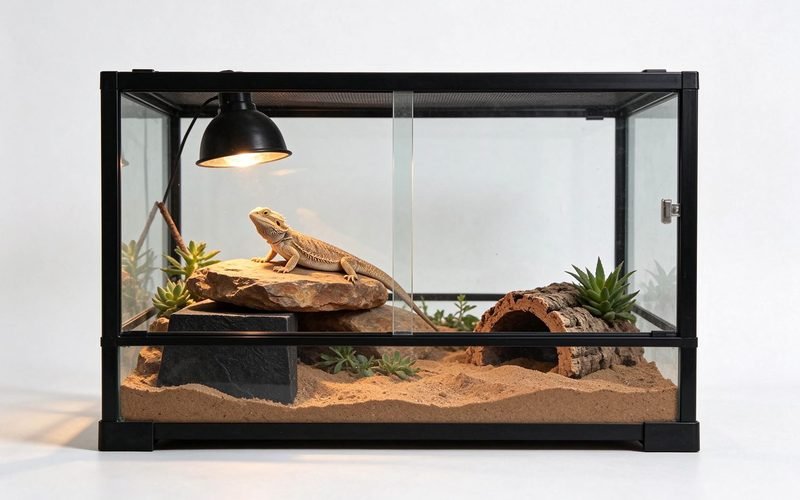
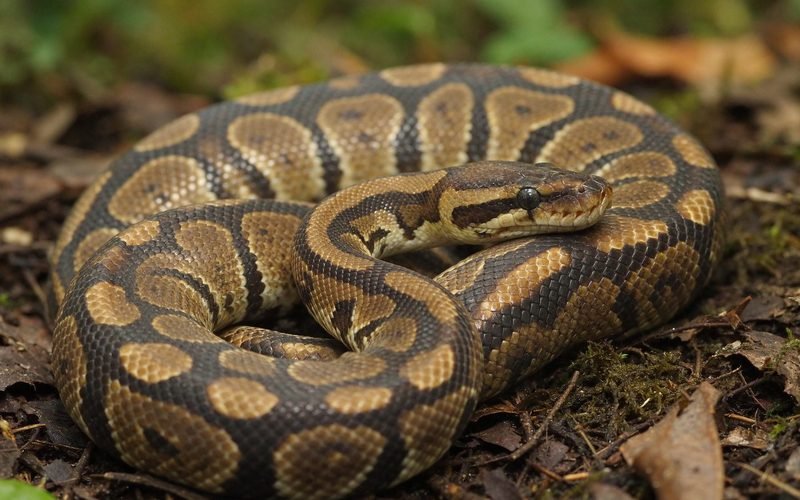
For a bearded dragon, the basking surface is roughly 42–45 °C, the cool end 25–29 °C, and the night drop is part of the design. For a ball python, the warm side is the high end of the species band and the cool side gives the snake a way out. The exact numbers differ by species; the principle does not.
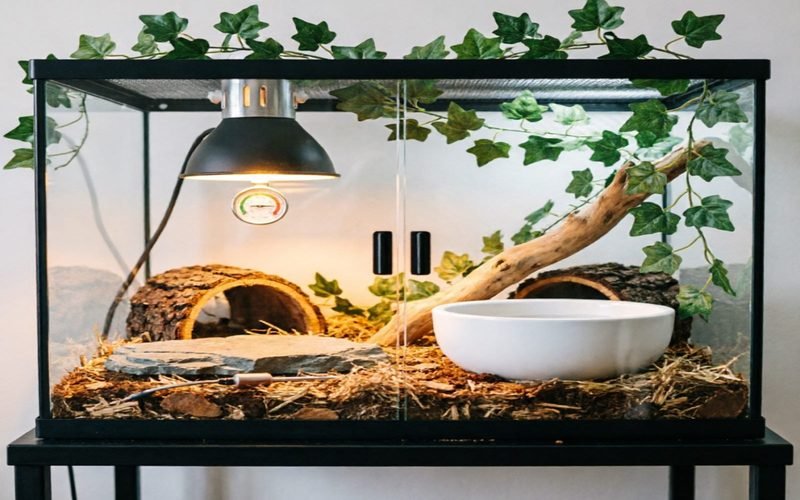
Put the basking lamp at one end, not the middle. A hide at each end lets the animal regulate without choosing between safety and temperature.
2. Humidity is a gradient too
A printed “60%” becomes 45–75% across a real enclosure. Measure the warm end and the cool end separately, and add a humid hide for shedding species rather than misting the whole tank. A shed that sticks at the tail or eye caps is a reason to check the gradient, not just the average.
3. Put the setup in this order
| Step | What to settle | Tool or guide |
|---|---|---|
| 1 | Species, age and adult enclosure footprint. | Habitat planner |
| 2 | Basking surface, cool end and night drop. | Bearded dragon setup / Snake gradient |
| 3 | Humidity band and a humid hide. | Shedding guide |
| 4 | UVB tube and calcium dusting schedule. | Lizard care centre |
| 5 | Log readings after every change. | Temp & humidity tracker |
4. What would make this a vet visit
Stuck shed around the eyes or tail, a burned belly, regurgitated food, a reptile that has stopped eating for more than its normal fast, or a sudden change in basking behaviour. Correct the gradient first, but do not delay a vet call for a burned or obstructed animal.
SOURCES & REVIEW
- Management and Husbandry of Reptiles — Merck Veterinary Manual.
- Environmental Diseases and Traumatic Injuries of Reptiles — Merck Veterinary Manual.
- Ball Python Humidity and Temperature Requirements — ReptiFiles.
Educational information, not a diagnosis or treatment plan. If your reptile is unwell, contact a licensed exotic veterinarian.